End of YouTubeClickbait
AI summaries of any CCed video in seconds. Know the key points, defeat clickbait, and learn 10x faster.
-
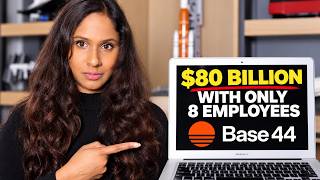
TL;DR — AI-powered platforms like Base 44 are generating multi-million-dollar valuations with tiny teams, signaling a major structural shift in the job market. While this hyper-productivity enriches founders and investors, it heavily reduces entry-level hiring and wealth distribution.
-
Key Points
- 00:00 — Base 44, an AI-powered no-code platform, was acquired by Wix for $80 million after operating for just six months with only eight employees.
- 00:50 — Similar companies like Lovable generate massive annual recurring revenue (ARR) per employee—far exceeding traditional SaaS industry benchmarks.
- 02:00 — Base 44 founder Mayor Schlommo ran the company mostly by himself using AI as leverage for engineering, sales, and support, proving AI supercharges experienced individuals.
- 04:30 — Stanford studies show AI's impact on employment manifests not through massive layoffs, but through a severe lack of new hiring for junior roles, especially in AI-exposed fields.
- 06:00 — This creates a paradox for career pipelines: if companies only hire senior workers paired with AI, future senior workers miss out on gaining foundational junior-level experience.
- 08:45 — Financial gains are heavily concentrated; instead of payroll being distributed to hundreds of employees, equity and wealth concentrate among a tiny group of founders and investors.
- 11:00 — IMF research suggests AI worsens wealth inequality because asset owners capture savings from reduced labor costs, depriving workers of both salaries and equity.
- 13:00 — The ultimate irony is that AI models are trained on collective human knowledge, yet the economic rewards are concentrated into a very small group of hands.
-
Takeaways
- Leverage AI for Maximum Output: Experienced professionals can use AI agents and no-code tools to execute multi-role tasks (engineering, sales, support) that previously required large teams.
- Anticipate the Junior Talent Bottleneck: Organizations must find new ways to train entry-level workers, as AI is currently wiping out the traditional bottom rungs of the career ladder.
- Reevaluate Wealth and Equity Distribution: Founders and leaders should consider alternative models for sharing company upside (such as broader equity pools) to offset the economic inequality driven by ultra-lean, AI-driven scaling.

-
TL;DR — As traditional silicon scaling nears its physical and economic limits, researchers—particularly in China—are exploring alternative materials and paradigms like 2D transistors, wave-based computing, and single-electron memory. While these breakthroughs won't replace silicon overnight, they could eventually bypass the need for advanced EUV lithography and reshape global technological leadership.
-
Key Points
- 01:33 — Silicon is hitting fundamental limits in physics (quantum tunneling, high heat, and leakage currents) and economics, where shrinking transistors requires exponentially more expensive lithography equipment.
- 02:34 — Gallium oxide emerges for power electronics (handling high power with low losses), though it is not suitable for high-performance CPUs due to poor heat dissipation.
- 04:36 — Two-dimensional materials (like molybdenum disulfide) enable atomically thin channels; Chinese researchers have successfully built sub-nanometer gate transistors and logic gates, though low manufacturing yields remain a hurdle.
- 06:40 — Wave-based computing explores using light, acoustic, or graphene-based electron liquid waves to perform complex mathematical operations like interference natively, boosting efficiency for AI.
- 09:23 — Single-electron memory devices operate at room temperature, dramatically reducing the energy consumed by constantly moving data between memory and processors.
- 11:00 — US and Western sanctions restrict China's access to ASML's EUV lithography, incentivizing China to leapfrog traditional silicon paths through novel architectures and materials.
- 13:09 — Future computing will not rely on a single universal material; instead, electronics will fragment into specialized components (silicon for base tasks, alternative materials for power, photonics for communication).
-
Takeaways
- Embrace Specialization Over Miniaturization: The future of computing relies on diverse materials and specialized blocks (waves, photonics, 2D structures) rather than simply shrinking silicon nanometers.
- Watch Alternative Innovation Paths: Technological sanctions can backfire by forcing lagging nations to innovate completely new paradigms instead of playing catch-up on a monopolized track.



Your Day, Hijacked by Fluff
Time is your most valuable asset. Here’s how YouTube spends it for you.
- 9:00 - 9:25A 25-minute tutorial where the 2-minute solution is buried at the end.
- 14:30 - 14:45A 15-minute 'review' that pushes affiliate links instead of giving a clear answer in 1 sec.
- 19:45 - 20:20A 'quick' video that leads to a 35-minute rabbit hole of irrelevant content.
Why do I have to watch half a video just to know if it's actually useful?
There's a smarter way...
Know the contentbefore you watch
Click the  for an Instant Summary
). An AI-powered summary will be generated in seconds.See What Viewers Think, Too
Learn Faster or Move On
View & Exportin One Place
-
TL;DR — AI-powered platforms like Base 44 are generating multi-million-dollar valuations with tiny teams, signaling a major structural shift in the job market. While this hyper-productivity enriches founders and investors, it heavily reduces entry-level hiring and wealth distribution.
-
Key Points
- 00:00 — Base 44, an AI-powered no-code platform, was acquired by Wix for $80 million after operating for just six months with only eight employees.
- 00:50 — Similar companies like Lovable generate massive annual recurring revenue (ARR) per employee—far exceeding traditional SaaS industry benchmarks.
- 02:00 — Base 44 founder Mayor Schlommo ran the company mostly by himself using AI as leverage for engineering, sales, and support, proving AI supercharges experienced individuals.
- 04:30 — Stanford studies show AI's impact on employment manifests not through massive layoffs, but through a severe lack of new hiring for junior roles, especially in AI-ex
-
TL;DR — As traditional silicon scaling nears its physical and economic limits, researchers—particularly in China—are exploring alternative materials and paradigms like 2D transistors, wave-based computing, and single-electron memory. While these breakthroughs won't replace silicon overnight, they could eventually bypass the need for advanced EUV lithography and reshape global technological leadership.
-
Key Points
- 01:33 — Silicon is hitting fundamental limits in physics (quantum tunneling, high heat, and leakage currents) and economics, where shrinking transistors requires exponentially more expensive lithography equipment.
- 02:34 — Gallium oxide emerges for power electronics (handling high power with low losses), though it is not suitable for high-performance CPUs due to poor heat dissipation.
- 04:36 — Two-dimensional materials (like molybdenum disulfide) enable atomically thin channels; Chinese researchers have successfully built sub-nanometer ga
From Chaos to Clarity
Drag the slider to see the difference. Stop watching, start understanding.
The Old Way
The 25-Minute Gamble
Hunting for the answerSkipping ads and fluffLosing focus to clickbaitThe PeekaTube Way
The 3-Second Summary
Get key takeaways instantlyAccess relevant timestampsAchieve zero distractionsStop Wasting Time on Clickbait.
Peekatube gives you instant AI summaries of any YouTube video, so you know what it’s about before you click
Pro Plan
Unlimited AI summaries for any YouTube video
- Lightning-fast summaries for any CCed Youtube video
- Unlimited video summaries
- Also includes:
- Early feature access
- One-click summary & transcript export
- Priority support
- Chrome extension
- or $44.99/year (save 25%)
Frequently Asked Questions
Everything you need to know about PeekaTube
Have more questions?
We're happy to answer any questions you might have